
Teaching telling the time usually becomes difficult once pupils move beyond simple clock faces.
O’clock and half past may be manageable, but times such as 2:50, 3:45 and 8:55 ask pupils to track the hour hand, count minutes, use “past” or “to” language and sometimes work out how much time has passed.
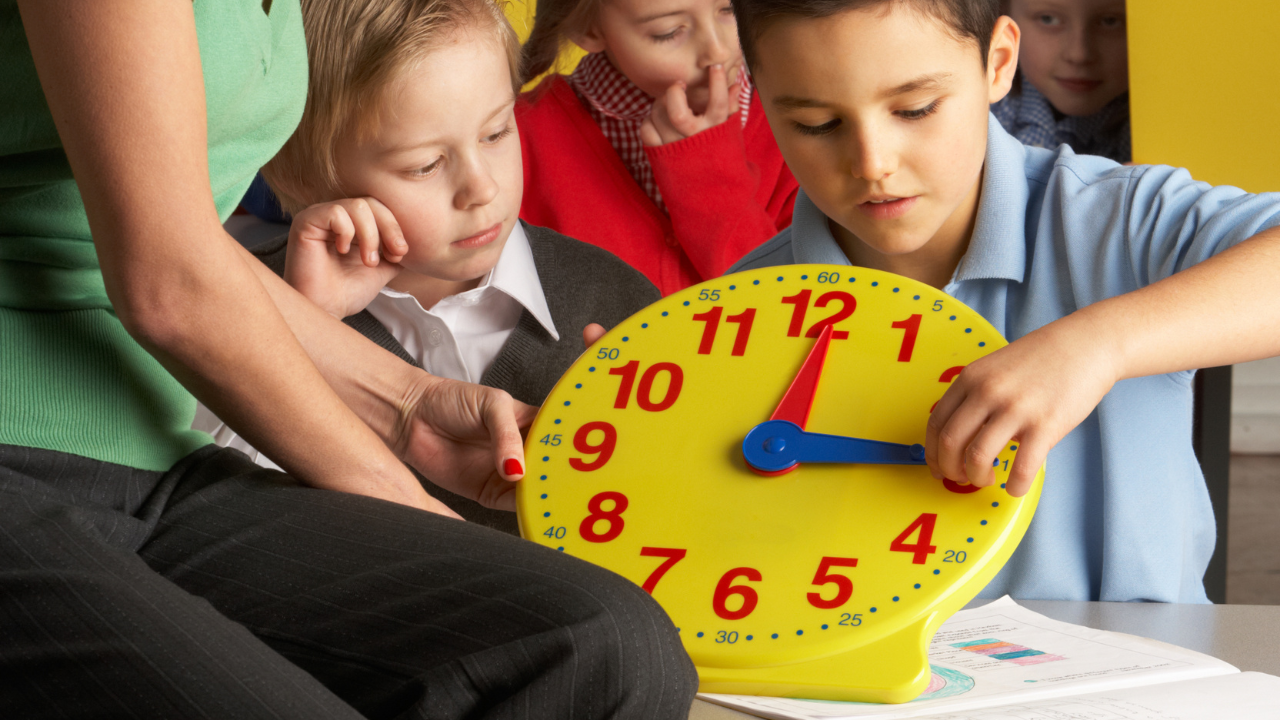
This post looks at those common errors. The aim is not to start again from the beginning or add more clock worksheets. It is to identify the part pupils are finding difficult, model that part clearly, and give them a quick way to check their answer. A floor clock, song, worksheet or matching game can all be useful, but not because a resource does the teaching on its own. It helps when it is matched to the part pupils are finding difficult.
Quick answer
Pupils often struggle with telling the time when they can read simple clock faces but have not fully connected the hour hand, minute intervals, spoken time, digital time and elapsed time. The most useful approach is to identify the exact error, model the missing link and check it with a similar example. Songs, clocks and games can support practice, but the adult role is to make the structure clear and decide whether pupils need more modelling, more practice or a smaller step.
1. Identify the error before choosing the task
More practice only helps when it is aimed at the right problem.
A class can look broadly confident with time while pupils are struggling with different parts of it. Some may need more work on five-minute intervals. Some may need more work on the hour hand. Some may read clock faces accurately but struggle as soon as elapsed time appears.
A quick check before the task can save time.
Useful checks include:
- show 2:50 on a blank clock face
- match 3:45 to quarter to four
- explain why the minute hand on 8 means 40 minutes
- say two ways to describe 5:30
- show the time from 8:55 to 9:20 on a number line
These checks give better information than another full page of mixed clock faces.
If the problem is the hour hand, more counting in fives will not solve it. If the problem is “to” language, pupils need help naming the next hour, not more general time vocabulary.
The useful question is:
Can you name the error in one sentence?
That keeps the teaching focused on the specific error pupils are making.
2. Make the minute scale clear
A clock face uses the same printed numbers for hours and minutes.
This is one reason pupils misread five-minute intervals.
The 4 can mean 4 o’clock, but it can also mean 20 minutes past. The 9 can mean 9 o’clock, but it can also mean 45 minutes past. The 12 can mean 12 o’clock, 0 minutes or 60 minutes.
When pupils are guessing around the five-minute marks, it is worth making the minute scale clear before returning to the full clock face.
A quick board model is enough:
- 1 = 5 minutes
- 2 = 10 minutes
- 3 = 15 minutes
- 4 = 20 minutes
- 5 = 25 minutes
- 6 = 30 minutes
Then ask what happens after 6.
This helps pupils see the clock as a 0 to 60 structure, not just a circle of numbers from 1 to 12.
You can also draw a 0 to 60 number line, count in fives, then curve it back into a clock. This makes the link between the number line and the clock face clearer.
The check is simple:
Can pupils explain why the minute hand pointing to 7 means 35 minutes past?
That explanation matters more than just getting the answer right. It shows whether pupils understand the minute scale.
3. Check the hour hand when the minute hand has moved
The hour hand often shows whether pupils understand the time or have only learnt a clock-reading routine.
A pupil might place the minute hand correctly for 4:50, then leave the hour hand exactly on 4. That error is useful because it shows what needs attention.
The pupil may know where 50 minutes is, but may not yet understand that the hour hand moves gradually through the hour.
Use examples such as:
- 2:30
- 2:50
- 4:45
- 8:10
- 11:55
The important thing is not only whether pupils can say the time. Look carefully at where they place the hour hand.
At 2:30, it should be halfway between 2 and 3. At 2:50, it should be close to 3. At 8:10, it should be just after 8.
A useful model is to move the minute hand slowly from one hour to the next and ask pupils to track the hour hand.
Ask:
- Where is the hour hand now?
- Is it still exactly on the hour?
- Which hour is it moving towards?
This does not need much explanation. Pupils need to see the movement and say what is happening.
The check is:
Can pupils place the hour hand accurately for 5:45 without being reminded?
4. Teach “to” language through the next hour
Quarter to and twenty-five to are difficult because pupils have to name the hour that is coming next.
“Quarter past 3” is usually easier because the named hour is 3. The clock has just gone past 3.
“Quarter to 4” is harder because pupils have to see 3:45, understand that 15 minutes remain, and name 4 as the next hour.
That is why pupils may read 3:45 correctly as a digital time but still call it quarter to three. They have noticed the 3, but they have not shifted to the next hour.
Use close pairs:
- 3:15 = quarter past 3
- 3:45 = quarter to 4
- 5:15 = quarter past 5
- 5:45 = quarter to 6
- 8:15 = quarter past 8
- 8:45 = quarter to 9
Then ask:
- Which hour have we gone past?
- Which hour are we moving towards?
This keeps the focus on direction, not just the words past and to.
Be careful with shortcuts such as “to means before.” They can help some pupils, but they do not solve the problem if pupils are still naming the wrong hour.
The check is:
Can pupils explain why 6:45 is quarter to 7, not quarter to 6?
The important point is the next hour.
5. Keep analogue, digital and spoken time linked
Pupils can practise each format separately and still struggle when the formats are mixed.
This is common.
A pupil may read analogue clocks in one lesson, digital times in another, and spoken times in another. Then a mixed question shows that the links are not fluent yet.
A simple routine is to show one time in three ways.
For example, write:
4:45
Ask pupils to show or say:
- the digital time
- the analogue time
- the spoken time
- another spoken version, if useful
For 4:45, pupils might say:
- 4:45
- quarter to 5
- 45 minutes past 4
- 15 minutes to 5
These are different ways to describe the same time.
Keep the examples small and deliberate. Three well-chosen examples are usually more useful than a large matching sheet.
The check is:
Can pupils move from one format to another without changing the time?
That is the point of linking same time examples.
6. Use a number line for elapsed time
Elapsed time is often clearer on a number line than on a clock face.
When pupils are finding the time between two points, the clock face can become too busy. They have to manage the hands, the hour crossing, the minute count and the final answer at the same time.
A number line keeps the time passed visible.
For example:
8:55 to 9:20
- 8:55 to 9:00 = 5 minutes
- 9:00 to 9:20 = 20 minutes
- total = 25 minutes
Another example:
2:40 to 3:15
- 2:40 to 3:00 = 20 minutes
- 3:00 to 3:15 = 15 minutes
- total = 35 minutes
A simple structure is:
Start time → next hour → end time
This stops pupils treating time like ordinary subtraction. It also keeps attention on the duration, which is the part pupils need to find.
Once pupils are confident, they can use more efficient jumps. At first, the next hour is a useful anchor.
The check is:
Can pupils draw the jumps before they give the answer?
That shows whether they are finding time passed, not just trying to subtract the numbers.
What teachers should avoid
The main thing to avoid is giving more practice before checking what the error actually is.
Try to avoid:
- giving more clock-reading worksheets when the problem is the hour hand
- accepting hour hands that stay exactly on the hour for times like 4:50
- rushing “to” language before pupils can identify the next hour
- assuming digital time is secure without checking the analogue link
- keeping analogue, digital and spoken time separate for too long
- using floor clocks or games without a clear teaching focus
- expecting elapsed time to follow automatically from clock reading
- moving on because pupils completed one worksheet accurately
A better approach is to choose one check before the next task.
Can pupils build the time?
Can they say it another way?
Can they explain where the hour hand should be?
Can they show how much time has passed?
Those checks are quick, but they make the next teaching move clearer. They help you choose the right check before more practice.
A simple way to teach telling the time
This sequence is for focusing a short teaching moment on the specific error pupils are making.
Use it as needed. Some classes will need the full sequence. Some will only need one part.
- Choose one time that exposes the problem
For hour-hand work, use 2:50 or 8:45.
For “to” language, use 3:45 or 5:50.
For elapsed time, use a start and end time that crosses the hour.
- Ask pupils to build it
Use mini clocks, a board clock or a quick drawn clock.
Do not correct too quickly. The first responses will show the pattern of errors.
- Name the error clearly
Keep it specific.
“The minute hand is right, but the hour hand is too far back.”
“You have read 45 minutes correctly, but named the wrong hour.”
- Model the missing link
Move the clock hands, draw the 0 to 60 number line, or match the digital and spoken versions.
Keep the model tied to the error you saw.
- Try a similar example
Change the hour but keep the structure similar.
After 2:50, try 5:50.
After 3:45, try 6:45.
- Finish with one explanation
Ask pupils to explain the part that mattered.
For example:
“Why is the hour hand nearly at 3?”
“Why is this quarter to 6?”
That is enough for one focused teaching moment.
The aim is not to make the lesson longer. It is to make the next step more precise.

How parents can use this at home
Parents can help with short, normal time talk rather than a full home lesson.
This is worth keeping low-pressure. Parents do not need a worksheet pack or a full explanation of the teaching sequence.
Give them a few prompts linked to normal routines:
- “We’re leaving at half past. Where will the minute hand be?”
- “It’s 7:45. That’s quarter to 8. Can you see why?”
- “Dinner is in 20 minutes. What time will that be?”
- “Swimming starts at 4:15. Is that before or after half past?”
- “The oven says 6:50. Is that closer to 6 o’clock or 7 o’clock?”
Analogue clocks are useful because pupils can see the hands. Digital clocks are useful because pupils meet them constantly.
The helpful part is linking them in small moments.
Parents do not need to recreate school at home. A few small prompts during the week are enough.

Final thoughts
The difficult parts of telling the time are usually specific and easy to miss.
A pupil can look confident with o’clock and half past, then still struggle with 2:50, quarter to language or elapsed time. That does not mean starting the unit again.
It means choosing a sharper check.
Look at the hour hand. Show the minute intervals. Link analogue, digital and spoken time. Use a number line when the question is about duration.
Then use your judgement. Some classes need more time with the 0 to 60 structure. Some need more spoken-time rehearsal. Some need elapsed time pulled away from the clock face for a while.
Silly School Education has maths songs, videos and tutorials that can help pupils rehearse time vocabulary and key maths language. They work best alongside clear modelling, well-chosen examples and teacher checks that show when a concept needs more practice.
Frequently asked questions
These are the questions that usually sit underneath recurring time mistakes.
Why do pupils read the minute hand correctly but place the hour hand wrongly?
They may not have fully understood that the hour hand moves gradually between numbers. Times like 2:50, 4:30 and 11:55 are useful checks.
Why is quarter to harder than quarter past?
Quarter to asks pupils to name the next hour. Quarter past keeps them with the hour they have just passed.
Should analogue and digital time be taught separately?
They can be introduced separately, but pupils need regular links between them. Otherwise they may read each format in isolation without seeing that they show the same time.
What is the best quick check for the hour hand?
Ask pupils to show 2:50 on a blank clock. If the minute hand is right but the hour hand sits exactly on 2, that shows the hour hand needs attention.
Why do pupils struggle with elapsed time?
Elapsed time asks pupils to find the time between two points. That needs a calculation structure, not just clock reading.
Should elapsed time be taught on a clock or number line?
Both can be useful, but an open number line is often clearer when pupils are crossing the hour or losing track on the clock face.
Are clock games useful?
They can be useful when the focus is clear. A clock game that practises the exact error pupils are making is more useful than a general clock activity.
How can parents help at home?
They can use everyday times: leaving the house, dinner, bedtime, clubs, cooking timers and journeys. Short, natural questions are enough.
Liked this teaching idea?
Try the full Silly School library free for 7 days.
Get access to 900+ songs, videos and tutorials, plus hundreds of downloadable resources for phonics, grammar, maths, geography, science and more.
Start your free 7-day trial